By SYLVIE DRAKE, Times Staff Writer
When Raymond Chandler asked in 1949, "Why is it that
Americans do not see the strong element of burlesque in my work?," little
did he know that, one year later, a young man aptly named John William
See, would be born to answer it. See saw—and gave the world "The Lady
Cries Murder," a Chandler parody within a parody that opened Sunday at the
Matrix.
See was not the first to see, however. Chicago's
Organic Theater did a Chandler parody in 1979 and suggestions of the same
idea have become popular on many fronts recently. But so far "Lady" is the
best, written of its genre and certainly the wittiest. It has its
weaknesses, but the production at the Matrix, if a little unsteady, is
very handsome and gains enough momentum as it progresses that the
possibilities, if not entirely realized, are strongly visible.
"I heed a gimmick," wails Charles Sartone, the
drippingly successful author of the play within the play.
And playwright See instantly delivers several. Prom
that point on—an early point—things pick up. We move into a hilarious 1938
world of sexy women, hard liquor, missing persons, pretzel-plot twists,
guns and gumshoes and funny lines. (A sampler: "He was shot 790 times ....
The officer who investigated said it was suicide.")
Production values are impeccable. The action unfolds on
a gray, all-purpose set excellently devised and lit by Gerry Harriton and
Vicki Baral who have proved their worth to this theater more "than once.
Charles Berliner has designed wonderful '30s costumes in every combination
of black and white to give us the feel of those pre-war detective flicks.
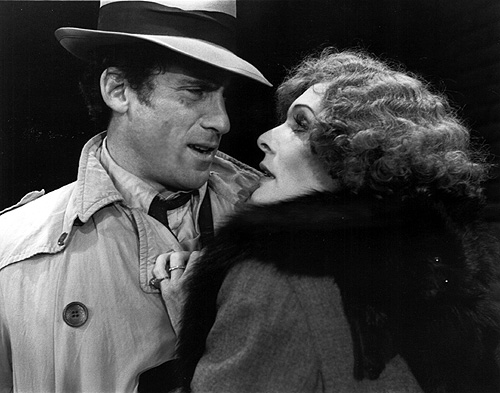
And the hero, of course, is Philip Diamond, the nearsighted dick who's
hired, in the play within the play, to unravel the disappearance of—well,
several people. No sense giving away the plot, particularly since it would
be hard to do. Suffice it to say that the show becomes densely populated
with cops, robbers, butlers (all played by Ray Stewart), one dowager, a
secretary (well, two), libidinous forsaken wives and Shanghai Sue, who
can't pronounce her "r's" and whose last name is Spivak.
Charming nonsense, all of it, with our hero spouting
such lines as, "Call it a hunch, call it plot expediency...," or
another character threatening loudly, "Just because I'm a stereotype don't
mean I don't get my way." You get the drift. And See gets subtle too.
There's nothing wrong with "I dreamt beautiful dreams, the kind of dreams
butterflies have when they envision Chinese philosophers."
The problems—there are problems—are mostly with getting
the device on the road. The opening scenes are forced, definitely so in
the acting, but one suspects in the writing as well. Early allusions that
Sartone might be shamelessly plagiarizing one Raymond Chandler
(while Mrs. Sartone flits brainlessly in and out of the scene) are awkward
and heavy-handed. It is not until we get into the show within the show
that the real fun begins.
It's clear that director Joseph Hardy knows where the
play should go and how, but the production at the Matrix is not quite
crisp enough and that seems largely because of casting. This kind of spoof
requires rigorously precise, intellectual acting where craft and technique
supersede all else. Not everyone in this company has the training or skill
to do that with the women in particular falling short of the mark. They
push just a little too hard and forget to let the lines do the work they
were written for.
Of the men, Paul Michael Glaser (lately of "Starsky and
Hutch") is a sharp deadpan, nearsighted diamond in the rough; though the
early joke about his refusal to wear glasses is mysteriously abandoned by
the writer about halfway through the show. Robert Picardo is terrific as
thug Raoul Jamaica; Randy Patterson makes a super lummox as Shanghai Sue's
birdbrained boyfriend, and Pat McNamara and James O'Connell are a
splendidly matched pair of cops ("Tweedle-dum and Tweedle-dumber"). As for
James Ray. who comes on late as the beleaguered Chandler, he almost steals
the show with a delightfully confused and innocent performance.
Jay Garner's Charles Sartone (and also his Jasper
Grunt, a character he plays in his own play) is too frankly overstated. It
weakens the effect Sam Anderson is much better as the wily Swordfish than
as the straight-arrow lawyer Kreskin in the play's opening, moments, but
that's as much the playwright's responsibility as anyone's. And Stewart as
a variety of stewards and one announcer, does the best he can with a
collection of fairly nondescript roles.
It was stated early on that Joe Stern and his Actors
for Themselves, who are presenting the play, have great expectations for
it. At this point it's not ready for Broadway, or to put it a better way,
it's doubtful Broadway would be ready for it A little fixing of the
opening scenes, a little recasting and this show has the potential of a
"Dames at Sea" in the sophistication of its clever satire and
tongue-in-cheek parody. Off Broadway might be the wiser place to start
(though a mid-size theater in L.A. might also do nicely, thank you).
REVIEW - L.A. DAILY NEWS
By RICK TALCOVE
All fun and no play seems the best way to. describe
John William See's "The Lady Cries Murder," now being presented by Joseph
Stern's Actors for Themselves at Stern's attractive Matrix Theater in
Hollywood.
Under Joseph Hardy's brisk, efficient direction, See's
script attempts to find fresh humor in yet another satire on detectives of
the '30s and '40s in. the Sam Spade and Philip Marlowe tradition. Helping
to put over this slightly dated idea is an attractive production, suitably
designed and lit by Gerry Hariton and Vicki Baral, with fine costumes from
Charles Berliner...
Where the production excels is in its casting. "The
Lady Cries Murder" is a holiday for some professional actors out to strut
their stuff.
Most conspicuous in this new-found freedom is Paul
Michael Glaser in the pivotal role of Philip Diamond. Yes, Glaser starts
out with the properly surly look we all know from his "Starsky and Hutch"
days. But once the script gets going, he comes up with an assured comic
performance.
He is good enough to make one wish he would try a
legitimate comedy the next time out on stage.
The rest of the cast is made up of equally talented
pros. Caroline Me Williams (from TV's "Benson") is seen in two roles — one
of them a variation on Mary Astor in "The Maltese Falcon." Funny Julie
Payne also does double duty as a follower of our hero and an aging dowager
— both satirically on target. Jay Garner is quite funny as a plagiarizing
writer.
Amusing as well in their various assignments are James
Ray, Robert Picardo, Ray Stewart, Haunani Minn, Randy Patterson, Kathleen
Doyle, Sam Anderson, James O'Donnell and Pat McNamara.
As deftly performed as it is, "The Lady Cries Murder"
does not offer anything more than you might see on TV. But if that
home-viewing audience can be lured to the Matrix and decides to go along
with the fun, everyone may go home happy.