DANGEROUS CORNER (1997)
Return to the list of Past
Productions

DANGEROUS CORNER
written by J.B. PRIESTLY
directed by ANDREW J. ROBINSON
starring
Julia Campbell and Anna Gunn as "Betty Whitehouse"
David Dukes and Granville Van Dusen as "Robert
Chatfield"
Lynnda Ferguson and Marilyn McIntyre as "Olwen Peel"
Gregory Itzin and Lawrence Pressman as "Charles
Stanton"
Jay Karnes and Raphael Sbarge as "Gordon Whitehouse"
Claudette Nevins and Susan Sullivan as "Freda Chatfield"
Claudette Sutherland and Kitty Swink as "Maud Mockridge"
Rachel Robinson - Standby, "Betty Whitehouse"
CNN covers Double-Casting at the
Matrix
during rehearsals for "Dangerous Corner":
REVIEWS:
Variety, Friday, May 30, 1997
by Charles Isherwood
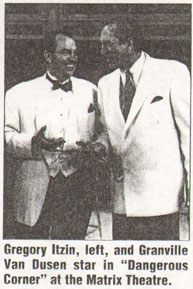 There's
no onstage rainstorm, and no Victorian tollhouse tipping hack and
forth like a Disneyland attraction, spewing china toward the
footlights, but the Matrix Theatre Company's production of J.B.
Priestley's "Dangerous Corner" is a lively entertainment
nonetheless. With Priestley's "An Inspector Calls" - and the
aforementioned special effects — proving a surprise smash in London
and on Broadway, this is a canny choice for one of L.A.'s premier
small companies, though it shows its age more than "Inspector" did. There's
no onstage rainstorm, and no Victorian tollhouse tipping hack and
forth like a Disneyland attraction, spewing china toward the
footlights, but the Matrix Theatre Company's production of J.B.
Priestley's "Dangerous Corner" is a lively entertainment
nonetheless. With Priestley's "An Inspector Calls" - and the
aforementioned special effects — proving a surprise smash in London
and on Broadway, this is a canny choice for one of L.A.'s premier
small companies, though it shows its age more than "Inspector" did.
A 1932 mystery melodrama that hews more closely
to the traditions of those genres than the 1946 "Inspector," which
had a thicker overlay of social import, "Dangerous Corner" concerns
the death of a principal in a publishing house, Martin Chatfield,
and the reverberations from his apparent suicide among his family
and business associates a year later.
Assembled after dinner on the patio of a cozy
country home, handsomely created by Deborah Raymond and Dorian
Vernacchio, are Robert Chat field (Granville Van Dusen), Martin's
brother and the head of the firm; his wife Freda (Claudlette Nevins);
her brother Gordon (Raphael Sbarge), also in the firm; and his
glamorous, flighty wife Betty (Anna Gunn); the firm's other partner,
Charles Stanton (Lawrence Pressman); and Olwen Peel (Marilyn
Mclntyre), loyal secretary at the company.
The play's mustiness comes through early, in the
characterization of the late Marlin: After hearing him described as
"handsome, charming and so amusing," no prizes for guessing what
Martin's big secret was. But in fact everyone onstage has a secret
relating to Martin's untimely death, which took place just as a
scandal involving money stolen from the firm threatened to unfold.
And as the evening progresses, one by one these
genteel folk are forced to confront the harsh, sordid truths beneath
the illusions they live by — rather as in "Inspector Calls," truth
be told. The play's title is taken from a line of dialogue likening
truth-telling to speeding around a perilous curve.
It's all rather formulaic: Each character gets
his or her moment of mortification as a secret is revealed, and
someone is forever saying "Yes, it's true!" with varying degrees of
defiance or shame. If the Matrix cast under Andrew J. Robinson's
pacy direction can't quite make it seem fresh, they certainly make
this theatrically conventional play sparkle with wit and suffused
emotion.
Itzin's Gordon is lull of sly, wry cynicism.
"Isn't it terrible?" he deadpans sarcastically when his guilt is
discovered. He plays best against the conventions of the material.
Mclntyre's deliciously named Olwen Peel is mousiness incarnate, with
a permanent look of wounded pride.
As the self-satisfied Freda, Nevins has an air of
regality being quietly shaken to its roots, and Gunn comes through
in the second act with some shiny steel beneath the gloss of the
glamorous figure she cuts in the first.
With only the occasional bootable line (Olwen
shudders at the recollection of Martin showing her "those beastly,
foul drawings of a mad, Belgian artist..."). "Dangerous Corner"
still provides the kind of theatrical flair that audiences once took
for granted, and in the Matrix company's capable hands, it's an
old-fashioned pleasure.
BackStage West - CRITIC'S PICK
by Zach Udko
"Life has a lot of dangerous corners, if you don't
chose your route well," says one of J.B. Priestley's two-faced characters
in his intriguing and fascinating mystery Dangerous Comer. Under Andrew J.
Robinsons adroit direction, the Matrix Theatre Company coasts
smoothly through this exceptional play without even the slightest pothole
or skid mark. The result is a production that makes it clear why the
Matrix may be the best theatre company in town.
As we saw last year in Stephen Daltlry's glorious
production of An Inspector Calls al the Ahmanson Theatre, Priestley
had a knack for creating characters with enormous complexities and
well-constructed facades. Small talk soon turns into a fierce search for
the truth, as a group of publishers and their wives begin to find out what
happened to one of the partners on the fateful night of his death. No
statement goes unexamined, or uncross-examined, by this determinedly
"charming little group" as pieces are put together in one great puzzle.
As always at the Matrix, at least two actors portray
each role; the performers are mixed and matched for each performance to
create a new experience each night. On the night reviewed, each of the
seven members of the ensemble were in top form. Most notable were Marilyn
Mclntyre's portrayal of a distraught secretary and Granville Van Dusen's
exceptional take on the dogged, heavy-drinking publishing boss. Lawrence
Pressman brings a sardonic twist to his no-nonsense character, and as the
boss' doting wile, Susan Sullivan skillfully demonstrates her character's
need to maintain order and civility.
Robinsons direction even manages to accentuate some of
the more humorous elements of the ridiculous sequence of events, while
maintaining a fast-paced, suspenseful tempo throughout the show. There's
not a dull moment in the production's 90-minute roller coaster ride.
Kudos go to an expert design team, namely Deborah
Raymond and Dorian Vernacchio for an exquisite set, J. Kent Inasy for an
effective lighting design, and Naomi Yoshida Rodriguez for picture-perfect
costumes.
New Times
"To Tell the Truth"
Dangerous Corner is a British play with a distinct, delightful American
accent
by Edmund Newton
A gathering of rich Americans is a little different
from a gathering of comfortably well-to-do English people. While the
peculiar Brits tend to be unabashedly rich (they've been doing it for so
long), we colonials are usually wealthy with an explanation. There are
many styles of loaded, of course, but Americans are often either crassly
self-absorbed in their wealth—the famous nouveau riche—or just
neurotic about it. The Poor Little Rich Girl is strictly an
American phenomenon. This is the tight divide that director Andrew J.
Robinson unwittingly wriggles into in his richly stylish staging of J.B.
Priestley's 1932 play Dangerous Corner, now at the Matrix
Theatre. Here's a British play with an American cast: So do you let the
actors dust off their "I says" and "old boys," pretending to be as English
as roast beef and mint sauce, or do you just let it rip Yankee style?
Robinson lets it rip—and he comes up with some interesting shadings in the
process.
The story concerns a clubby little group of friends,
most of them partners in a successful publishing firm, who suddenly find
themselves compelled to tell the truth; they sweep away all of the
disguises and half-truths that help them get over the rough spots in their
complicated lives. A mysterious visiting novelist (Claudette Sutherland)
somehow loosens their tongues, and one thing just seems to lead to
another.
There are certainly some suppressed truths to utter
here, mostly about the late Martin Chatfield, once a partner to some of
the folks on the stage. Martin was a man whose personality must have been
so elastic he could have extended it several times around the handsomely
spacious conservatory where the group gathers (elegantly designed by
Deborah Raymond and Dorian Veraacchio) and still had enough left over to
hold up his pants. Depending on who's telling the story, Martin was either
a dashing, sensitive, grabby pornography-lover and a lamenter who was
troubled by moral dilemmas or a ruthless society warrior who was "cruel as
a cat."
The play bristles with sudden shocking revelations and
cliff-hanger announcements, including one hilarious disclosure about
Martin's death at the end of Act One, leaving such a huge question mark
that the suspense may send you rushing back to your seat before
intermission ends. The cast plays it all with deadly seriousness,
resisting the urge to camp it up, giving the performance an edge that's as
sharp as a carving knife.
But who are these long-legged women in expensive
dresses and these self-satisfied men in evening jackets? One thing they're
not is Americans pretending to be the familiar English aristocrats
who loll around drawing rooms; despite some awkwardly British modes of
expression (such as, "Oughtn't we make sandwiches?"), all of them speak
American.
By doing it that way, Robinson risks having the
audience scratch its head in puzzlement here and there. Julia Campbell, as
the deliciously hoity-toity Betty Whitehouse, a princess from the depths
of her rapacious heart, is a little too precious, even for a rich American
debutante. But most of the time, the Americanization of the play adds
texture to the characters. Gregory Itzin, as the unscrupulous fellow who,
it seems, has stolen some money (it's a long story), transcends
Priestley's English cad to become a touchingly Lomanesque figure pursued
by failure. Claudette Nevins, as a hearty society woman, finds in her part
a little bit of the brassy Texas oil heiress who doesn't need servants
around to mix up something tasty in a skillet.
Jay Karnes, as the spoiled rich boy who idolized
Martin, makes himself a lot more interesting than some fey British
dilettante, and David Dukes, as the blustery head of the firm, unsheathes
a convincing element of danger and unpredictability in the part. Lynnda
Ferguson is also fine as Olwen Peel, the secretary to the publishers, who
brims with surprises.
Speaking of unpredictability, there are two full casts
for the production, two actors for each role, and there's a different mix
for every performance. On this night, the audience left savoring the
experience, like diners who have just consumed a light but exquisite
repast. Suspense, interesting characters, moments of high drama,
surprising turns—Dangerous Corner is a pleasure from start to
finish.

FEATURE ARTICLES
BackStage West
"Lynnda Ferguson & Susan Sullivan"
Reporting by Laura Hitchcock
Lynnda Ferguson and Susan Sullivan arc
working together some nights in the Matrix Theatre's long-running
current production of J .B. Priestley's "Dangerous Corner"—the show is double-cast, true to Matrix form, with two actors assigned to
each role and the casts mixed and matched in different
combinations each performance. (Ferguson trades off with Marilyn Mclntyre, and Sullivan with Claudette Nevins.)
Ferguson has played leading roles on stages
across the country, including Neil Simons "Rumors" on Broadway, lady
Anne to Stacy Keach's "Richard III" in Washington, D.C., and "Hedda Gabler" at South Coast
Repertory. She worked
previously at the Matrix in "Mad Forest" and "The
Homecoming." TV appearances include "Almost Perfect, "News Radio," and "Picket Fences," and she stars in the upcoming
feature "Raven's Blood" with her husband, John Walcott, with whom she
just wrapped another film, "Making Contact." Sullivan, a two-time
Emmy nominee for "Falcon Crest," has starred in many series and miniseries,
including "The Monroes," "The George Carlin Show," "Rage of Angels," "Rich Man, Poor Man," and "Midway." Her stage background began on
Broadway opposite Dustin Hoffman in "Jimmy Shine," and includes
productions at the Mark Taper Forum and in regional theatre.
Sullivan is now also appearing in her first feature film, "My Best
Friend's Wedding."
The two met recently before a performance to talk
about their craft and their livelihood.
Susan Sullivan: This double-casting is the most
interesting theatrical experience I have ever had. When I came into it, I
said at the first read-through, "Well, there's gotta be an Alpha actor in
each role—somebody who is the leader." And really there isn't. Have you
had that experience?
Lynnda Ferguson: What I found, particularly in The
Homecoming, and to a lesser degree in this, is that because everybody in
the different roles was so different, who I was in the play was different
depending on the combination of people. I mean, the domino effect of the
combination of personalities is such a turn-on. I feel like I don't ever
want to do it any other way.
Susan: It is fascinating. In the initial stages of the
rehearsal process, I found that when I would do something on the stage, I
would be really interested to see if Claudette would do die same thing.
Now, of course, I know better.
Lynnda: Well, this is your first time doing this.
The first time did it, in The Homecoming, the person I partnered
with was more of a known quantity at the Matrix, Sharon Lawrence—she had
already done several, so I felt coming into The Homecoming that I
needed to shadow her more...
Susan: That's what I felt.
Lynnda: —that I needed to do more what she did. I
made her like the Alpha. In fact, before we did Dangerous Corner,
[producer] Joe Stem called me up and said, "OK, Lynnda, I want you to
just own this. Don't be afraid to try what the other people are doing, and
don't be afraid to do your own thing."
Only Reconnect
Susan: You know, for a long
time, I went from one series to another, and I never had to get up
and create anything for myself. I sort of forgot how to do it—or maybe I
never really knew how. I decided I wanted to do a play and work in the
theatre, so I pursued this myself. I had started reading plays and giving
them to director Andrew J. Robinson, who happens to be my neighbor.
Lynnda: I didn't know that.
Susan: And doing this play rejuvenated my feeling
about my art, and about one of the things you forget, which you discover
coming back: that there is this artistic family you belong to, which
nurtures you in a way that nothing else does. I didn't even know how much I missed it and how much it would mean to me
to reconnect to it. For the kind of work that's gonna feed your soul, for
the most part you gotta rely on yourself.
Lynnda: Absolutely To get drawn to the places where
you can do exciting work for yourself requires effort. Agents and managers
in Hollywood have nothing to do with that.
Susan: Ultimately, you have to create your own life
as an artist. It seems to be a need thing—that you need to express
this part of yourself. What was happening to me in my own life was that I was trying to push it away. I was trying to find other outlets:
I started
writing and painting, and all of that was fine, but it wasn't my primary
form of expression; it always seemed like the poor relative that you
were sort of trying to nurture along. I read a few years ago something
that Frank Langella said in SAG magazine: that the saddest thing that
happens to an actor is when they lose their passion. And what I was trying
to do, I realized, was to kill my passion so I wouldn't have this terrible
longing, as opposed to honoring the longing and trying to do something
with it that would be satisfying.
Lynnda: Why would you try to kill it?
Susan: Because I didn't want to be hurt. I didn't
want to be rejected. I felt abandoned by the business—because I was
abandoned by the business, in a sense. I mean, I shouldn't complain,
because I worked pretty consistently, but when you're used to working on a
series all the time, and then suddenly you spend six months or a
year not working—it was really shocking, and I felt, Well, I'm old now. I
had turned 50, and in this business they tell you your career is over at
40, so at 50 I thought, Well, I'm lucky—I got an extra 10 years! I think
if you buy that myth, you're really finished.
Hooked
Lynnda: It was a thrill for
me when I came to the first day of Dangerous Corner rehearsals and
I saw
you there. Because—and this is the truth—I hardly ever watch TV, but I happened to catch the premiere of
Falcon Crest, and I allowed myself to
get hooked on it. I watched it. It was like my show. And I loved you in
it. And I kind of thought, I want to be like her when I grow up. I did, I
really did. you were always like one of my favorite actresses.
Susan: Oh, Lynnda, I'm so... please, thank you.
Lynnda: It's true, and I watched as much as I could. People thought I was crazy. "You watch what?"
Susan: I remember the day, we were not far into the
rehearsal process, and you were leaving for the day, and I said, "Lynnda,
I think you're a wonderful actress." Do you remember that? You looked so
startled—everybody looked so startled—because actresses tend not to say
that to one another. And you know what? We should say it more.
Drama-Logue, May 22-28, 1997
Focus on Directing:
"Andrew J. Robinson Navitages Dangerous Corner"
by Tom Provenzano
As we speak Andrew J. Robinson is in the midst of very
difficult rehearsals for J. B. Priestly's Dangerous Corner at the
Matrix Theatre. In addition to the usual tough problems of staging a play,
he is working with a double cast.
None of these problems will slow him down. Robinson has
worked steadily as an actor for 25 years — he was the bad guy in Dirty
Harry and has a recurring role on Star Trek: Deep Space Nine —
and between film and television roles, he's remained part of the local
theatre scene. But when he began his involvement with producer Joe Stern,
Robinson found himself more into directing and has turned out to be rather
good at it. (Homecoming and Endgame at the Matrix received numerous
Drama-Logue Awards and a Best Director Awards from The Los Angeles
Drama Critics Circle.)
Drama-Logue: You have made a good living so long as
an actor, why did you decide to move into directing?
Robinson: "The problems that directing poses
for me in terms of my work are problems that interest me. How does one
pull together all the various elements of a theatrical production in the
service of a play?
"When I say, 'in service of the play,' I really mean
'of the production.' If the vision does not include everyone involved, if
the vision is just some abstract idea that the director has, then he comes
in and imposes upon the people and the play. Even if the vision is in tune
with the play and the play can support the vision, if that vision is
simply imposed, then it's pissing where you eat, because you are missing a
huge opportunity to get input from them."
Drama-Logue: Do you approach each play the same
way?
Robinson: "Yes, one step at a time. I go
back to what I call 'first principles.' I go back to asking what the play
means, what we are trying to say, what am I trying to say with the play?
Where are we moment-to-moment? I worry when there is a scene where the
story is not being told. That's what it comes down to: where is the story
not being told?
"For me this is all about story telling. I sometimes
forget that, sometimes get involved with the technical stuff or with one
person's performance, so totally involved with a moment that I can't see
the forest for the trees."
Drama-Logue: Before you begin rehearsals, do you
have the entire play blocked in your mind or on paper?
Robinson: "No. Rehearsals are total
exploration. The first week is sitting down and reading the play. Smart
actors really do love to know what they are doing. They love to know what
the text is about, how the text falls together, what are the themes here,
what logically leads from A to B.
"Actually most actors are quite relieved to have
someone who is going to sit down with them and go through it. I find that
most of the actors are not anxious to get up not knowing what the hell
they are saying. But ultimately you do get them up by saying, 'Now it's
time to get off our asses.' That's that. There has to be some amount of
leadership exercised."
Drama-Logue: Some worry that too much talk turns
rehearsals into a theoretical, intellectual exercise rather than a
dramatic one. Do you see a palpable difference in actors after the week of
reading and discussion?
Robinson: "Yes. As I am an unrepentant
English major who believes in subtext and believes that the good writers
leave room for individual subtext. With good plays the surface is
ambiguous enough, skillfully crafted enough, so that the actor has to come
in with his or her life experience and fill it. Not only just fill it with
their accidental life experience, but to fill it with conscious choices as
to how they are going to go against the text. How they are going to create
a counter-current to that text. So that we are not just hammering a nail
on the head, so that we have a dynamic the audience feels, but can't
consciously understand.
"The nail has to get a little bent. There are very few
plays worth their salt where there isn't a bend in the road. And this play
is called Dangerous Corner. Without that subtext you have
everybody going in what I call the Swing Blade direction — you have
the writer, the actor, the director all going in the same direction. If
there is nothing tugging you the other way, there is no dynamic. My
personal aesthetic needs to see opposition. That's my favorite kind of
theatre, I hate to see things hit on the head. Otherwise, what am I doing
there? What am I going to learn?"
Drama-Logue: But by allowing actors so much freedom
to experiment, don't you invite ultimate conflict between you as a
director and them as the creators of their character?
Robinson: "There always is. If you are asking an
actor to create sub-life, to create a life underneath the text that is
rich and full, then you are going 10 get into conflict with that actor. It
is especially true when you are trying to give them freedom, while working
on a period play. "This play is in the 1930s so we have a style here. The
real fine line of this play and problem of getting it together and the
success or failure of this production depends upon how well we walk the
line between style and subtext without falling into one or the other. So
the subtext overwhelms the style and you get into a very self-indulgent
thing. Or vise versa, so you don't fall into some airy style that
has no subtext.
"The 1930s is a fascinating period to work in. They had
a whole different way of living in their bodies — especially in a certain
strata of society. It's an English play that we've transposed to upper
middle class Eastern milieu — something I know about, being a New England
WASP.
"These people—especially the ones with homes in the
country, who come from old money and have lived with a certain mode of
behavior for generations — have a style. It is a style that does not exist
in Tennessee Williams or Arthur Miller. It is a style that is more
European than American. Although, contrary to perceived wisdom, there are
pockets of American culture and society that have this kind of style.
There is an elegance to their lives. Not only to each other, but about
they way they relate to their things; the way they smoke cigarettes; the
way they drink. So it is not just schlumping and naturalistic.
Drama-Logue: It sounds like you enjoy the process
of teaching actors about working in the period. Robinson: "I
hate to say it but there is some school marm in me. I have a vision or
aesthetic that, over my 50-odd years of living, has accrued within me — it
has built up. There are movies, there are plays that you would rather go
to than others. There is a certain style of acting, directing and
designing that give you more pleasure than others.
"Basically that's where I have come to. I like mystery,
but I love elegant mystery. I love the kind of mystery where there is
always the potential of an answer — a really socko devastating answer —
whether it pays off or not, so that you always feel that any minute now I
am going to learn something that will change my life. Whether my
expectation is fulfilled or not, I don't care."
Drama-Logue: Although you have had tremendous
success as a director, it is still a recent decision to devote most of
your artistic talent to that role. What have you learned of most
significance about directing over the past four years with The Matrix
Theatre Company?
Robinson: "The first one is to admit when I
don't know. Not to pretend that I do know. When I start pretending that I
know and start pretending to the others that I have the answers, they can
tell. I am a bad liar for one thing. But somewhere, on some level, actors
know that you are lying. That erodes trust.
'The other thing is that if I get stubborn and dig my
heels in and decide there is one solution to the problem, then I am being
a fool. Especially working with a double cast situation, because it is so
difficult.
"I have learned flexibility. When you have two actors
working with each character, each has a different way of solving his or
her problems than the other. Therefore for you to be able to help that
actor, you have to be aware of that. The solutions I come up with for one
actor may not work with another."
Drama-Logue: Also you must face the problem of
actors with vastly different techniques.
Robinson: "Yes, from every generation and every
orientation. I accept it. The thing about this group at the Matrix is that
every last one of them is a skeptic and they are not easy on directors.
That's okay because, as an actor, neither am I.
"I don't mean unreasonably so, I mean they ask
questions: Why, where, what, who, when? Where are we going with this?
Every one is different and if you try to give cookie cutter answers to
this group they'll laugh you out of the room and they won't trust you. If
you don't have their trust you don't have anything."
Drama-Logue: Your directing work recently has been
with the Matrix, but are you making plans to work in other venues? How
will you decide what plays to direct?
Robinson: "I like odd material. There was a play
last year called Saxon Shore by this amazing English playwright
David Rudkin who wrote Ashes. It is a far-out play. There is also
an Irish playwright I worked with over at Skirball Kennis named Billy
Roche. He has never been produced in this country. His plays are done in
Ireland and at the Royal Court in London. I got to know him and read his
plays. He has this one play I want to do called Calvacaders, a
beautiful piece."
Producer: Joseph Stern
Set Designers: Deborah Raymond & Dorian Vernacchio
Lighting Designer: J. Kent Inasy
Costume Designer: Naomi Yoshida Rodriguez
Prop Master: Chuck Olsen
Sound Designer: Matthew C. Beville
Production Stage Manager: R. Kevin Wais
Assistant Director: H.E. Greer
Casting by: Marilyn Mandel
Return to the list of Past
Productions |