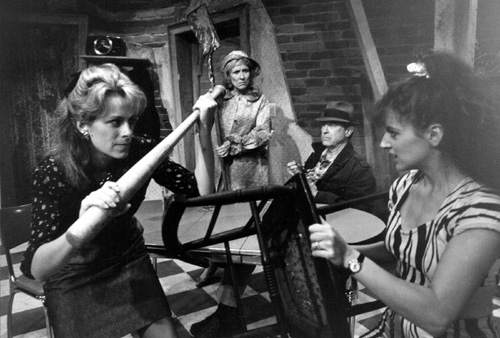
Jane Kaczmarek, Ctr: Barbara Tarbuck & Arlen Dean Snyder, Rt: Viiu
Spangler

L-R:L Jane Kaczmarek, Barbara Tarbuck & Alexandra
Gersten
Click on the pictures to see larger
versions.
Photos by I.C Rapoport
REVIEW: L.A. WEEKLY, Nov. 17, 1989
"Daddy Dearest"
by Steven Mikulan
Two fathers who don't know best
Like smoke wafting from a burning empire, the scent of
decaying family life commands modern playwrights' imaginations. From
Eugene O'Neill on, American writers have dissected the psychoses that
cause the nuclear family to split apart with destructive energy, often
finding parallels to our national political culture. Two productions
currently playing on L.A. boards focus on the decline of the American
family — and the body politic — although they view their characters'
conditions from radically different perspectives...
George F. Walker may be a Canadian, but his reading of
life south of the border is terrifyingly sharp, Better Living
begins with Nora, a widow with three adult daughters, digging in the
basement to expand the family home. She's fast-talking in that annoying,
schizophrenic way that usually marks sitcoms. Soon, however, we realize
that Nora's situation, while funny, is not so familiar. It seems that 10
years ago her cop-husband, Tom, took a powder after burning all the
family's clothing. That painful memory — and the knowledge that Nora and
her priest-brother Jack tried to kill Tom — has just about scarred over
when in walks the husband. Well, not exactly Tom, but rather a
similar-looking ex-drinking chum from Tom's years on the road who figures
he can impersonate the wandering breadwinner.
While the Tom manque is initially accepted by the real
father's daughters, Nora spots the cheat and eventually he admits his
impersonation. But he doesn't leave. Instead, he turns the messy,
emotionally chaotic household into an efficiently run work camp. His aim
is to fortify the exterior of Nora's home with razor wire as she continues
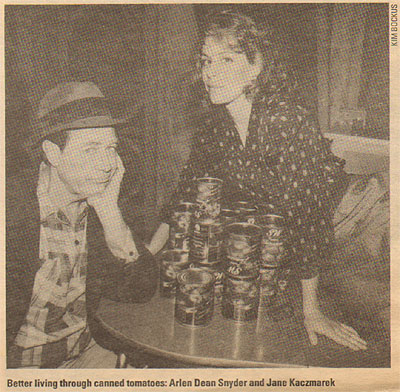
her subterranean expansion — all the while stocking up on canned
foodstuffs. The new Tom is convinced that apocalypse is 'round the corner
in the form of "secret armies of confiscation" — bands of Third World
invaders eager to pillage America. "I am the soldier of the total-shit
future," he claims, adding that his plan for Nora's family is "a kind of
socialism based on the reality of the place."
The acquiescence of Nora's family to Tom's benign
authoritarianism tells us as much about the collaborationist instincts of
American political life as did the complicity of the Lomans to Willy's
dementia. Nora tolerates it because Tom is a man who gets things done and
whom she finds attractive in a deja-vu way. Seventeen-year-old daughter
Gail was too young when her father left to really remember him, and at
first welcomes the substitute Tom. Mary Ann, the confused middle daughter,
seems to go along with the new order because it spells an end to her own
emotional turmoil, while lawyer-daughter Elizabeth, at first fiercely
defiant, in time recognizes in herself some of the same domineering
qualities that define Tom. In all these cases the characters allow
misplaced hopes for order and prosperity to paralyze their efforts to lead
independent lives. Only Jack, the former man of faith who now believes in
nothing, is unmoved by Tom, and it rests upon his shoulders to overthrow
the usurper.
In a way, Tom is Willy Loman by other means. Willy
constantly babbles about the nurturing past; Tom speaks of a hellish
future. Willy subjugates his wife, Linda, by his abruptness; Tom
neutralizes Nora through his protective ness. Willy trusts ihe world; Tom
is paranoid. Willy is the father who has never really been home for his
family; Tom is the dad who never goes away. Despite these differences,
when measured against their aims, Willy and Tom arc really flip sides of
the same coin; what matters most is their common goal of asserting
patriarchal authority over their respective families and that sacred
American institution, the Paid-for House.
Better Living,
more so than Salesman,
defines contemporary America's split self-image, one nominally formed by
idealism but more completely defined by compromise and expediency, a
political portrait lineated by equivocations and constantly shifting
allegiances. Its implications of frightening instability are made all the
sharper through Peggy Shannon's careful direction of a fine cast,
particularly Arlen Dean Snyder as Tom and Jane Kaczmarek as his nemesis,
Elizabeth. Snyder makes his character an amiable, slack-jawed talker who
just happens to be capable of remodeling a white middle-class home along
the lines of China's corrective May 7 schools. Kaczmareck, for her part,
is stunning as the aggressive, almost mannish Elizabeth, whose first
instinct is to kill her revenant father the moment he walks in the door.
In her scenes with Snyder, the tension is Elektra-fying.
REVIEW: READER'S GUIDE TO THEATER, Friday, Nov. 3, 1989
Better Living Through On-Stage Chemistry
By Joel Martin Levy
When Joseph Stern produces a play, one can usually count, on
at least two things: a script founded on clear intentions and a cast
that makes the most of its opportunities. Stern's latest offering
meets those expectations and goes beyond. Better living has a limited but definite goal,
which is to; make people laugh at fairly
serious craziness. This production succeeds because the key creative
people involved have understood that
objective, did not losei
sight of the fact that this play is
little deeper than its jokes, and remembered the importance
of not being earnest. Director Peggy Shannon and a wonderful cast have
saved us from solemnity.
The play, by George F. Walker, concerns a family
that has suffered deep emotional traumas and has responded to the
pain by coming unhinged. But this is no psychological drama; Walker
doesn't aim to analyze or illuminate his characters' problems. The
script merely brings together people with serious emotional distress
and provokes laughter by emphasizing the bizarre things they say and
do.
The action begins with the news that Tom, the
husband and father who had violently terrorized the family and was
driven away ten years earlier, has come back to town. The news is
delivered to Nora, Tom's wife, by her brother. Jack, a disillusioned
and cynical priest with a drinking problem. We soon learn that
before Tom's departure, Nora and Jack had attempted to kill him.
Jack fears detection, while Nora simply dismisses the news of Tom's
return, having already converted a fanciful dream she had about his
death into a firm belief in his demise.
Nora's loose grip on reality is borne out by her
circumstances. Her chaotic house is strewn with boxes of odds and ends and
smeared with soil, which Nora has tracked in from her excavation in the
back yard. A wild-eyed figure in dirt-spattered raincoat, hat, and muddy
rubber boots, she talks with messianic fervor about her digging of an
underground room. Although evidently a bit balmy, her motivation is
nevertheless touching: a desire to restore the unity of her shattered
family. She digs because she is convinced that her daughters will produce
offspring and return home and that the house will need more space. It
turns out Nora has company in wanting to bring the family together.
Tom, of course, moves in and acts. as the catalyst for
a series of developments culminating in the reconstitution of the family
as a sort of survivalist commune, preparing for the day when the dark
masses will arise from the Third World and try to take America's riches by
force. Oh, yes, Tom is a bit warped by fifteen years as a cop, the
violence of his family's breakup, and years of roaming in the
underdeveloped world. He has returned home to impose his survivalist
vision on his family and, by protecting them, to make amends for his
earlier brutality.
Each of the three daughters has suffered in her own
unique way. Elizabeth is completely absorbed in her career as an
aggressive lawyer and is utterly devoted to winning. Mary Ann, who has
separated from her husband and left her baby with him, is entirely
ineffectual, racked by guilt and worry and unable to make even the
simplest decision. Gail, who still lives at home, is a burned-out cynic at
seventeen and shows no interest in anything beyond copulation.
Tom's return, and his attempt to impose his will on the
family, provokes strong responses from this company of walking wounded.
The resulting confrontations are calculated to produce vaguely uneasy
laughter. It is enough to make any actor drool, and Stern has
gathered cast members with quite healthy salivary glands, all of whom have
fully exploited the possibilities.
Arlen Dean Snyder is a perfect Tom. His half-mad, yet
entirely plausible brand of strength and certitude is so charismatic that
it justifies the kind of love and hatred he inspires in the other
characters. All this guy would need is a bullhorn and a tent, and he could
establish a cult. Another delight is Barbara Tarbuck as Nora. She puts the
light of the truly inspired in Nora's eyes and doesn't fall into the trap
of simply playing a crazy lady. But it is Alexandra Gersten, in the role
of the helpless Mary Ann, who generates the most laughs. She is not only
funny in the part, but also has a lovable quality, much like Woody Allen
in his most popular roles. Appollo Dukakis plays Jack with a nice mix of
world-weariness and avuncular sweetness, Jane Kaczmarck is appropriately
frenetic as the tightly wound Elizabeth, Glenn Plummer has some funny
moments as Gail's boyfriend Junior, and Viiu Spangler plays Gail with a
hard edge and just enough intimations of adolescent vulnerability.
Better Living is a funny play, though it lacks
true insight and provocativeness. What makes this production so worthwhile
is the clarity and unity of creative vision, which is evident in the cast
and in the hundreds of individual choices made in the direction and
performances. Director Shannon and the entire creative team make it real
and funny, avoiding numerous opportunities to indulge other impulses. They
must have known that the play would not sustain deeper intentions. They
have succeeded masterfully in making Better Living hit its mark.

